Environmental performance is becoming an increasingly important consideration for lenders, investors, and multinational procurement teams. Sustainability initiatives, ESG performance and operational efficiency are playing a growing role in financing discussions, supply chain partnerships, and long-term business relationships. For organizations across the UAE, integrating sustainability into operational planning can contribute to stronger stakeholder confidence and greater long-term value creation.
Five Energy Trends Every UAE Business Should Be Watching
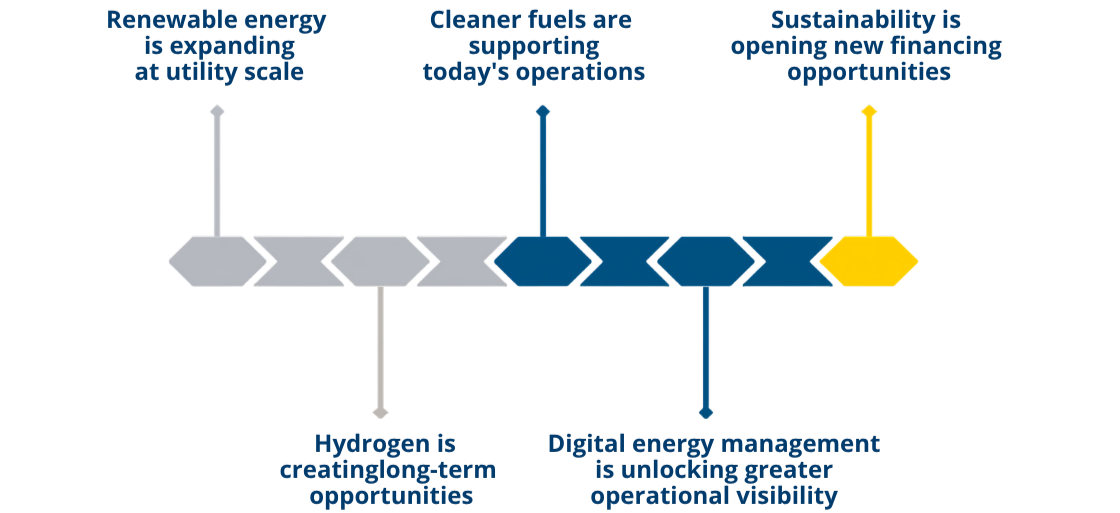
1. Renewable energy is expanding at utility scale
Renewable energy has become a major component of the UAE's national energy strategy, supported by some of the world's largest clean energy developments. The Mohammed bin Rashid Al Maktoum Solar Park has already reached a production capacity of 3,860 MW and is expected to exceed 8,000 MW by 2030, significantly above its original target of 5,000 MW. Together with electricity generated by the Barakah Nuclear Energy Plant, these investments continue to strengthen the country's clean electricity capacity at utility scale.
Business impact
As clean electricity capacity continues to expand, businesses can benefit from increasing access to diversified energy sources while strengthening long-term energy planning and supporting corporate sustainability objectives.
2. Hydrogen is creating long-term opportunities
Hydrogen continues to attract significant strategic investment across the UAE as part of the country's long-term energy ambitions.
Leading organizations including ADNOC and Masdar are investing in hydrogen production and supporting infrastructure, helping establish the foundations for future commercial applications.
Today, hydrogen offers particularly strong potential for sectors such as heavy transport, shipping and industrial processing, where lower-emission energy solutions can support future operational requirements.
Business impact
For many organizations, hydrogen represents an important long-term opportunity. Monitoring developments today will help businesses prepare for future applications as technology, infrastructure and market adoption continue to evolve.
3. Cleaner fuels are supporting today's operations
As the UAE's energy landscape evolves, cleaner conventional fuels continue to play an essential role in supporting commercial transport, construction and industrial operations. Since 2014, the UAE has required diesel containing no more than 10 ppm sulphur, helping reduce sulphur-related air pollutants while supporting the efficient operation of modern vehicle emissions-control systems. Alongside cleaner diesel, biodiesel and other lower-emission fuel alternatives are receiving increasing policy support through the UAE's National Policy on Biofuels, which provides a framework for standards, production, trading, distribution and use. The continued development of cleaner fuel solutions allows businesses to enhance operational performance while supporting broader sustainability objectives across existing fleets and equipment.
Business impact
For many organizations, cleaner fuels, efficient fleet management and proactive maintenance offer practical opportunities to improve operational efficiency, optimize fuel consumption and support emissions reduction as part of a broader energy transition strategy.
The UAE's energy transition extends beyond the evolution of energy sources. It also encompasses the technologies that enable businesses to manage energy more efficiently, make informed decisions,, and optimize daily operations. Across industries, organizations are adopting smart energy infrastructure to gain greater visibility over fuel consumption, asset utilization and operational performance. Technologies such as smart metering, telematics, IoT-enabled fueling systems, RFID controls and digital fleet monitoring are helping transform energy management from a manual process into a strategic business capability.
With access to real-time operational data, businesses can improve fuel accountability, strengthen cost control, enhance fuel security and support more accurate sustainability reporting. Greater visibility also enables faster decision-making and more efficient resource planning across fleets, facilities and job sites.
Business impact
For fleet-dependent and industrial businesses, digital energy management supports better operational performance through improved visibility, more informed planning and greater control over energy resources.
5. Sustainability is opening new financing opportunities
Sustainability continues to influence the way businesses access capital and demonstrate long-term value. Across the GCC, green bonds, sustainability-linked financing and ESG-driven lending are expanding, with the UAE playing an increasingly important role in advancing sustainable finance across the region. As environmental performance becomes more closely linked to investment decisions, organizations with clearly defined energy transition strategies are well positioned to strengthen stakeholder confidence and support long-term business growth.
Business impact
Businesses with credible sustainability initiatives and structured energy transition roadmaps can enhance investor confidence, strengthen commercial relationships, and create new opportunities for long-term financing.
Key Considerations for Businesses
The UAE's energy transition presents significant opportunities, and every organization will progress at its own pace depending on its operations, infrastructure and long-term objectives. For many businesses, planning future investments requires balancing operational priorities with emerging technologies and evolving sustainability goals. Areas such as energy storage, electrification, and new fueling infrastructure may involve phased implementation, while existing fleets and industrial assets can continue delivering value alongside gradual operational improvements.
Businesses operating across multiple Emirates or sectors may also benefit from structured planning that aligns with applicable regulatory frameworks and reporting requirements. As sustainability expectations continue to evolve, strengthening internal capabilities in areas such as energy efficiency, emissions reporting and ESG strategy can support informed decision-making and long-term resilience
Organizations that integrate these considerations into their broader business planning are well positioned to maximize the value of future energy investments.
Building a Practical Energy Transition Roadmap
Every business has a different starting point, making the energy transition an opportunity to develop solutions that align with operational priorities and long-term objectives. A practical roadmap begins with understanding current energy consumption, identifying opportunities to improve operational efficiency, and establishing clear performance benchmarks
Many organizations are already delivering measurable improvements through cleaner fuels, optimized fleet operations, proactive maintenance programs and smarter energy management systems. Investments in monitoring, reporting, and digital infrastructure further strengthen operational visibility while supporting compliance and sustainability objectives.
Success also depends on working with experienced partners who understand both the evolving energy landscape and the operational realities of implementing change across complex business environments. By combining strategic planning with practical implementation, businesses can build a transition roadmap that delivers operational value today while supporting future growth
Building Tomorrow's Energy Strategy
The UAE continues to demonstrate global leadership by developing a diversified energy ecosystem that combines renewable power, nuclear energy, cleaner fuels, digital innovation and emerging technologies. For businesses, this creates an environment where operational excellence and sustainability increasingly complement one another. Every improvement in fuel efficiency, operational visibility, infrastructure, and energy planning contributes to stronger business performance and long-term resilience. The organizations best positioned for the future will be those that view energy as a strategic business asset; one that supports productivity, strengthens competitiveness and creates lasting value across every stage of their operations.
At IPT Energy, we believe the energy transition is built through practical progress. By combining reliable energy solutions, cleaner fuel options, smart technologies and deep operational expertise, businesses can continue powering growth while contributing to a more sustainable and resilient future.
FAQ
The UAE Energy Strategy 2050 provides a long-term national roadmap focused on improving energy efficiency, expanding clean energy capacity, and reducing carbon emissions. For businesses, it offers greater confidence when planning investments, infrastructure, and long-term operational strategies aligned with the country's evolving energy landscape.
Yes. Conventional fuels remain essential for sectors such as logistics, construction, heavy transport, and industry. Cleaner fuel standards, including 10 ppm sulphur diesel, together with lower-emission alternatives such as biodiesel, support more efficient operations while contributing to broader sustainability objective

Every organisation's journey is unique. Many businesses begin by improving fuel efficiency, adopting cleaner fuels, investing in digital monitoring technologies, and strengthening operational visibility. These practical steps help build a strong foundation for long-term energy planning and sustainable growth.
Industries with significant energy requirements, including logistics, transport, construction, manufacturing, industrial operations and large commercial fleets—are among those most actively integrating cleaner energy solutions, digital technologies and sustainability initiatives into their operations.

Digital technologies such as telematics, IoT-enabled fueling systems, RFID controls, and smart monitoring provide businesses with greater visibility over energy consumption and operational performance. This supports more informed decision-making, stronger cost control, improved operational efficiency, and enhanced sustainability reporting.